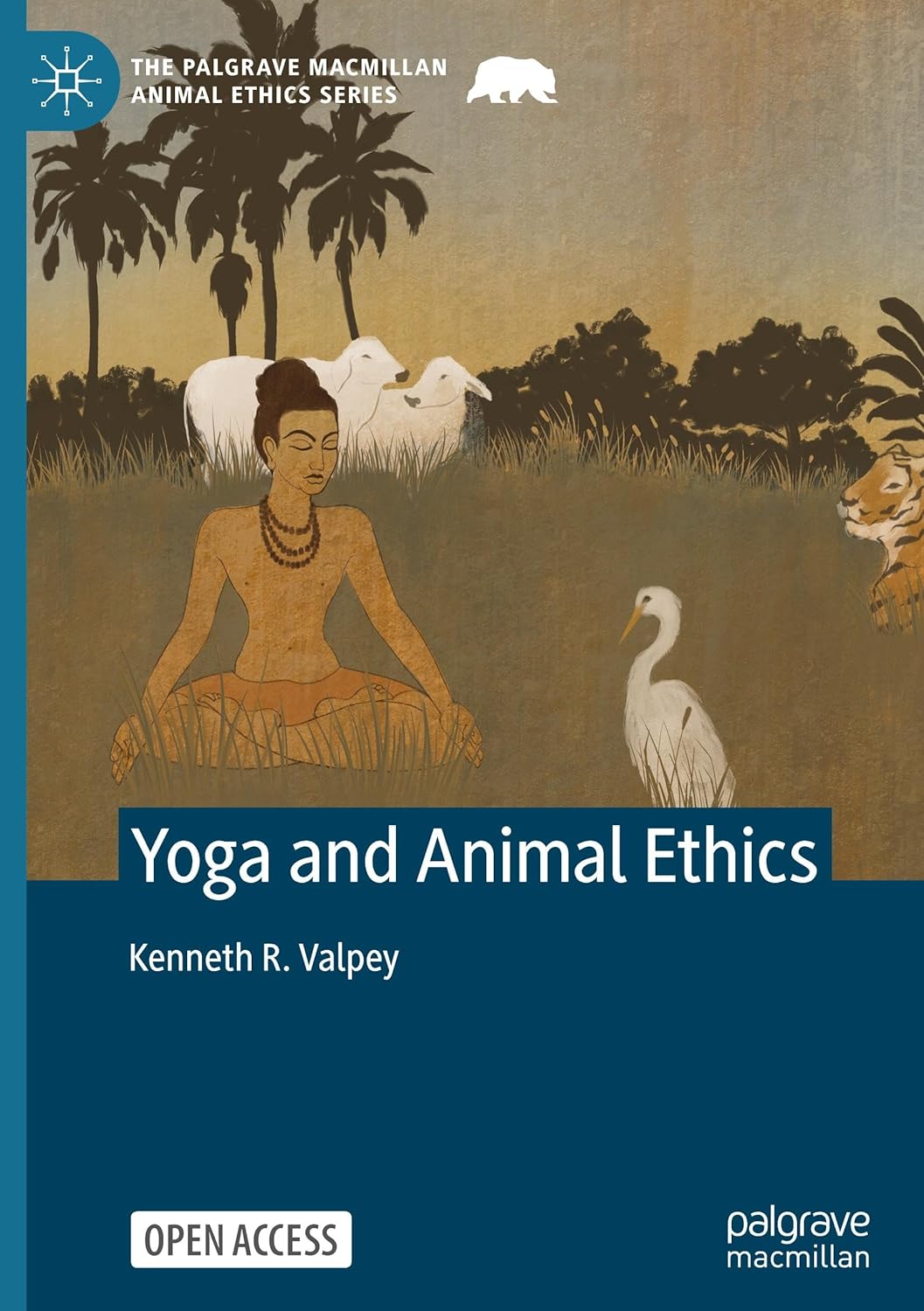

Conscious Ethics: Transforming Ourselves to Transform the World
Based on a talk by Dr. Kenneth R. Valpey
We live within a powerful, pervasive worldview. Scholar Mark Fisher termed it "capitalist realism"—the widespread assumption that our current, consumer-driven system is the only viable reality. It's a "value-neutral" framework that shapes our very imagination, making it, as Fisher noted, "easier to imagine the end of the world than the end of capitalism."
This is not just an economic theory; it is a form of ontology. It actively organizes reality by reducing the world—its forests, rivers, and living beings—into a collection of resources to be managed, consumed, and exploited.
At the Bhaktivedānta Institute for Higher Studies, we believe this worldview is the root of our profound "alienation from our environment." As Dr. Kenneth Valpie (Krishna Ksetra Swami) notes, when we are "habituated to untruth... clamoring for justice and human dignity while ignoring the cries of the countless animals we eat," we yield a "constricted, impoverished, even crude sense of self."
Our ecological crisis, then, is inseparable from our ethical crisis. And this ethical crisis is rooted in a fundamental misunderstanding of reality.
The Blind Spot of Western Ethics
For centuries, Western philosophy has held a "blind spot" regarding animals. From Aristotelian divisions to the Cartesian idea that animals are mere machines without the capacity to feel pain, the prevailing assumption has been that ethics is a discourse exclusively for and about humans.
This convenient "fact-value divide"—the idea that a "fact" (an animal) is separate from its "value" (its right to live without suffering)—allows us to build systems that are "indifferent to ethics."
But what if this core assumption is scientifically and philosophically wrong?
The Undeniable Reality of Qualia
The BIHS perspective challenges this "value-neutral" model by re-establishing the primacy of consciousness. The only thing we know for certain, as Akhandadhi Dāsa explains, is our own conscious experience. The "redness" of red or the "feeling" of pain is an irreducible reality known as qualia.
This is not just a human phenomenon. Scientific evidence demonstrates that animals, too, experience qualia. Contrary to the old mechanistic view, animals are not just automatons. Researchers, for example, have shown that lobsters will consciously "change their behavior and put themselves in vulnerable... situations... in order to avoid pain."
They have a subjective, first-person experience of suffering. They are conscious.
This single fact shatters the "value-neutral" foundation of capitalist realism. If animals are conscious beings who experience qualia, they cannot be treated as mere "things" or "resources." An *is* (the animal is conscious) inherently contains an *ought* (it ought not be made to suffer).
The Missing Ingredient: Self-Transformation
But information alone is not enough. As Dr. Valpey points out, "so much has been written in recent years about animal ethics, but where is the change?" The meat industry, for example, continues to expand.
The missing ingredient is not more data, but transformation.
This is why the BIHS framework integrates the discipline of yoga as an essential component of ethics. Yoga is not just a set of postures; it is a path of profound self-transformation. It provides the tools to move beyond a purely intellectual understanding and actively change ourselves—to cultivate the discipline, attention, and "relationality" required to align our actions with our knowledge.
From "Value-Neutral" to "Value-Laden" Realism
This path of "yogic virtue," as described by Charlotte and Dr. Valpey, is a practice of "world-making." It challenges the dominant paradigm not just by critiquing it, but by living and enacting an alternative.
This alternative aligns with the work of Dr. Cogen Bohanec, a scholar of Hindu studies and ethics, who articulates the concept of "value-laden realism." This worldview, rooted in the Gauḍīya Vaiṣṇava tradition, understands value as inherent in reality. Love, compassion, and the sanctity of life are not subjective human opinions; they are objective, ontological features of a conscious universe.
Living ethically, then, is not just a personal choice. It is a way of "participating in the world more truthfully" and aligning ourselves with the very structure of reality.
"Small Is Beautiful": The Path Forward
How do we implement such a profound shift? The answer is not a top-down, global revolution. The answer, as Dr. Valpey suggests, is to "start small."
This is the power of what thinkers like Larry Rasmussen call "anticipatory communities"—what Charlotte terms "laboratories of world-making." These are small, local, and intentional communities that act as "examples" of a different way of living. They are the "small is beautiful" model in action.
By fostering a "circular, regenerative economy" (an idea found in the Bhagavad-gītā) and embracing a "Dharma-based communitarian approach," these communities become the "laboratories" where a new, more sane, and more compassionate reality can be "lived out" and, ultimately, inspire the world.